

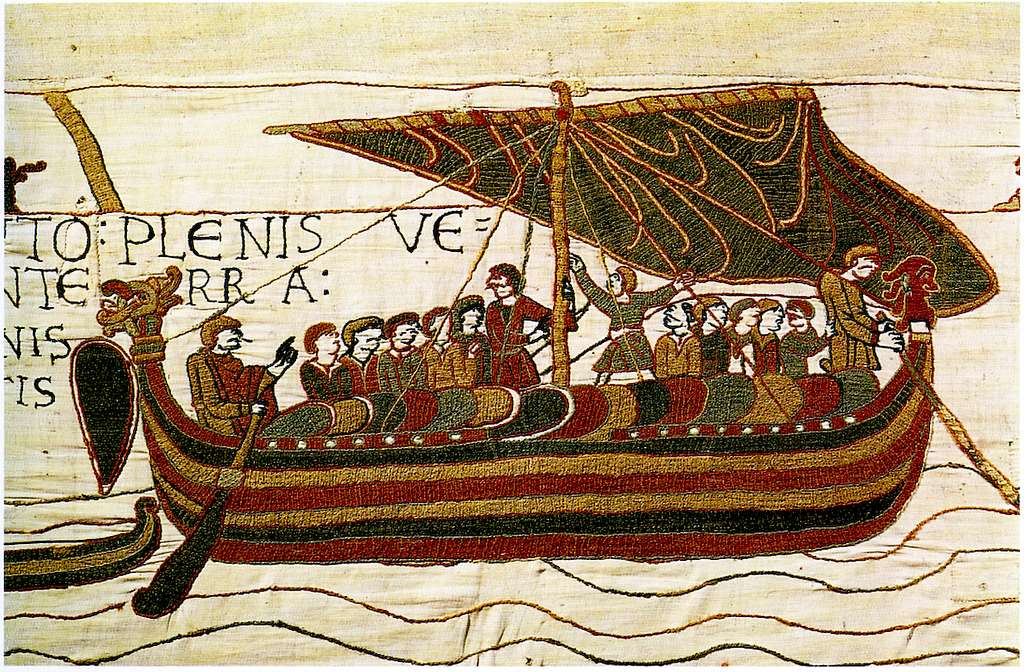
1066 is one of the most familiar years in English history: the Battle of Hastings, William the Conqueror defeating the last Anglo-Saxon king Harold, who is felled by an arrow in the eye. It’s a changing of the guard, the old order and the new, the beginning of England’s Norman French period and the end of the old “English” monarchy, culture and society.
When old friends from Oriel College, Oxford, Scottish schoolmaster W.C. Yeatman and journalist R.W. Yeatman created their parody of self-confident, Whiggish history books, 1066 and All That (1930), a “guide to all the history you can remember”, it is hard to see what other year they could have chosen as their point of departure. We all know the basic outline.
Or some of it. William of Normandy did indeed defeat King Harold II at Hastings on 14 October 1066, and he did bring with him different ideas about governance and the political community. William was French, or rather Norman, but his great-great-great-grandfather Rollo was born in Scandinavia, frequently described as a Viking, and became Count of Rouen in the early 10th century.
Harold Godwinson, Earl of Wessex, was half-Scandinavian too, his mother Gytha Thorkelsdóttir related by marriage to the ruling Danish house of Knýtlinga. We cannot say definitely whether he was killed by an arrow to the eye, as accounts of the Battle of Hastings vary—one early description has him falling to a Norman lance and being dismembered by four knights, one of them possibly William himself.
One story we think we know is Harold’s frantic attempt to ward off two separate invasions after he became king in January 1066. Edward the Confessor died on 5 January, leaving as his heir, if anyone, his great-nephew Edgar Ætheling, barely into his teens. But the following day the Witan, the Anglo-Saxon king’s council, instead chose Harold to be the next King. He was crowned the same day, possibly in the newly constructed Westminster Abbey, but there were two foreign princes who might have considered themselves to have better claims to be the Confessor’s heir. One was Duke William of Normandy, and the other was the King of Norway, Harald Hardrada.
Both challengers made plans to assert their claims by force. Harald Hardrada had allied himself with Harold Godwinson’s younger brother Tostig, displaced as Earl of Northumbria the previous year, and on 8 September he landed an invasion fleet at the mouth of the Tyne. Historians have debated whether Harald genuinely sought to be crowned King of England, whether the invasion was more to do with Tostig’s ambitions or whether it was a power play in the wider context of the “North Sea Empire” Cnut had constructed in the first half of the 11th century. But he posed a genuine military threat, with between 250 and 300 longships carrying 10-15,000 soldiers, and he soon began to move south.
The traditional narrative is that Harold Godwinson moved north to meet the invaders and the ensuing clash at the Battle of Stamford Bridge on 25 September saw Godwinson score a devastating victory: Harald Hardrada and Tostig were both killed, as were most of their fighting men. A force of around 10,000 was reduced to maybe as few as 3,000 survivors.
But then we have the tragic flaw which gives the events of 1066 such piquancy: three days after Stamford Bridge, late in the campaigning season, William of Normandy’s army landed at Pevensey Bay in Sussex, and Harold Godwinson had to lead his troops on a brutal forced march of nearly 300 miles to face Duke William. The Anglo-Saxon army was exhausted when it reached Hastings at the end of October, and that was a significant factor in the Norman victory. Never fight a war on two fronts.
Or was it? We should always be careful about what we think we know. Historian Professor Tom Licence returned to the original sources on the pivotal year for his forthcoming biography of Harold Godwinson, and found that there is no clear evidence that the forced march ever happened…

Professor Tom Licence
Was 1066 simply a succession crisis because Edward the Confessor died childless and handled the preparations for his succession badly? Or were there deeper weaknesses in the English kingship?
Edward had been lining up Edgar Ætheling as his adopted son and heir, with the support of Edith, Tostig and—at first—Harold. But in late 1065, the North rebelled. Edward’s regime could no longer hold together the country. Edgar, as his heir, no longer appeared viable because Edgar represented the continuation of Edward’s regime and the continued rule of Edith and Tostig, who had alienated the North. Harold, however, was able to do a deal with the northern earls, thereby keeping the country together and forging a new ruling regime, with himself at its head. He duly took the throne. Others, such as William, then thought that they too should have a go at seizing the throne because Harold lacked the legitimacy of a blood claim, and because England looked divided (with the rift between Harold and Tostig).
What kind of king was Harold Godwinson?
He didn’t have much time to show anyone. He was an astute man and a very capable general, who had studied the art of war. He was a grasping man too, though perhaps no more than any other great man in his position. Lords could rise and fall very rapidly in that world. They had to learn to survive, and to grow their interests, to prevent against disaster. Harold was skilled at negotiating and at winning people over, but he also alienated people by doing things his own way.
What do we know about contemporary views on the two invasions of 1066? What did Anglo-Saxon political observers think was going to happen?
Both seem to have come as a surprise. The ‘C chronicler’ even says that Harald Hardrada’s invasion came as a surprise. There is no evidence that the English expected William either (before hearing news of his preparations). The worst eventuality foreseen by Edward the Confessor’s contemporary biographer in early 1066, or thereabouts, was civil war—and possible fratricide—between Harold and Tostig (which indeed came to pass).
Apart from the alliance between Harald Hardrada and Tostig Godwinson, is there any suggestion of co-operation or collusion between any other claimants after Edward’s death?
There’s no evidence I would trust—i.e. good contemporary cross-referenced evidence. Only late stories and saga tales—the sort of legends that usually grow up around such events. Nor would I see Harald Hardrada and Tostig as claimants to the throne. Rather, I’d see them as men exploiting an opportunity to see what they could get, in the way of lands, titles, plunder, or shares in the kingdom.
Given the new evidence and a narrative that Harold sailed south rather than made an arduous forced march, does this suggest his decision to fight at Hastings was the right one?
I can’t fault any of his decisions. Battle (which was called Sandlake at that date) was the pinch-point at the exit to the Hastings peninsula, in which Harold had William bottled up. It was the logical point to block the invader’s exit onto the major roads that would facilitate his rapid movement around the country.
Harold, however, may not have wished to fight William. He may have hoped that William would stay in his fortifications at Hastings and not risk battle. Harold may initially have intended his army to perform a containing role, perhaps while it was waiting for more troops to show up. He may not have been at full strength when William attacked—a claim made in more than one of the English sources.
Do we know anything about the state of Harold’s fleet? Had it suffered any storm damage, or was the sea journey south routine?
The C chronicle records ships being lost in storms en route from the south coast to London in early September. It doesn’t say how many ships were lost. William also lost ships on the rocks between Dives and Saint-Valery, and he lost further ships which strayed from the main invasion fleet and landed at Romney (where their crews were killed by the local defence force). The sea journey south from the Humber to the Thames is (and was) a fairly easy one, in fair weather. It would have taken four or five days for a mediaeval fleet leaving the Humber to reach London (judging by rates of movement for mediaeval fleets, and by the length of time the journey took in later centuries). Harold, moreover, had access to additional vessels, for the Norwegians (according to the D chronicler) had arrived in 300 ships and left with only 24. An early twelfth-century chronicler, Geffrei Gaimar, who used a lost version of the Anglo-Saxon Chronicle from the North, adds that Harold seized those ships that remained. So he had access to maybe 200 or more ships, in addition to the fleet which he had already sent to the River Wharfe.
What does this tell us about the strategies of Harold and Duke William? How great were their respective logistical achievements—Harold’s in getting his army south again from Stamford Bridge, and William’s in getting the invasion force across the Channel so late in the campaigning season?
No duke had mounted an invasion of England before, so William’s achievement in transporting men, horses and equipment was unparalleled. It also required nerves of steel. A contemporary writer tells us of the tense wait for the wind to change at Saint-Valery, when the tears were streaming down William’s face, because he feared the whole operation might fail, so dependent was he on the winds and tides. Harold moved his army north very quickly and took Harald Hardrada by surprise—a great coup for his tactical initiative. We don’t know, however, what numbers returned to London with him. Loading men onto ships wasn’t too difficult. And the sea voyage was easier than marching or riding. In 1064, when Harold and Tostig conquered Wales, Tostig had taken a land army around the north coast, to ravage those lands, while Harold had gone around south Wales to ravage the south with a fleet. Given the option, on that occasion, of moving troops by land or sea, he’d chosen to move them by sea. This, then, would have been his preference.
Lots of details about the Battle of Hastings are unknown, but we know it was long, from about 9.00 am till dusk, while a lot of mediaeval battles are more or less over within two or three hours (Agincourt, Bosworth, Flodden). Does that tell us anything about the opposing forces or the two leaders?
It shows that it took William a long time to find a way to break Harold’s position, despite having the superior weapons system—i.e. William had a greater variety of troop types (foot soldiers, cavalry, archers, crossbowmen). That speaks to the strength of Harold’s defensive position. It may also suggest that William was unable to use all his troops to full advantage. Certainly by adopting a defensive position on the high ground, on rough terrain, Harold made it very hard for his opponent to do anything useful with his cavalry. The length of the battle also suggests that, all things considered, the two sides were evenly matched.
Was Hastings a must-win for William? Could he have sustained a longer invasion campaign, or would defeat at Hastings have forced him to retire to Normandy at least for the winter?
It was a must-win. Harold had him trapped on the Hastings peninsula, blocking both exits. His land army blocked the landward exit, while his fleet had gone round behind William to prevent his escape by sea. Reinforcements would keep flocking to Harold all the while he remained there—there was no shortage of the English to come to his aid. William, on the other hand, could not count on that hope of extra support coming to reinforce him in a foreign land.
I should probably add that I don’t think it was William’s original intention to land his fleet at Pevensey. His plan at first would have been to land in the Portsmouth/ Southampton (Portchester) area, where there was a large harbour, and march straight out onto the road system to Winchester, take the treasury, and proceed from there to London. He would not have been so easily trapped there. Pevensey, after his fleet was blown to Saint-Valery, was the only other option—and far less desirable from an invader’s point of view.
There’s been some resistance among historians to the idea of Harold’s army sailing south rather than marching. Do you think the evidence is ambiguous, or do historians find it hard to let go of narratives which have long been taken for granted?
I’m interested in the views of real experts—and there aren’t that many. Also, I talk with most of them, and the idea of Harold using the fleet isn’t new. What’s new is my finding that there’s no evidence of the forced march or ride, and my reading of the chronicler’s statement about the fleet going home. I’ve not met resistance to these views from specialist academic researchers. On the contrary, the leading experts rather like the argument.
History is about evidence, so anyone who wants to defend the old view needs to present their evidence that Harold’s men marched or rode from Yorkshire to London. I can present evidence of Harold having access to large fleets, both in Yorkshire and later in London—evidence from the earliest and best sources on either side of the conflict. And ships don’t sail themselves. I can also show that Harold, faced with the option of moving troops by land or sea on the campaign two years earlier in Wales, chose to move them by sea. Thus we have evidence of what he had done in a similar instance before, and evidence of the movement of hundreds of ships in the Humber and down around the south coast. But there’s nothing about his men marching or riding. It’s not conclusive, but it does give a steer (to use a nautical metaphor).
Certainly there are people with very rigid views. But as historians we need to be open to multiple possibilities, and keep our options open. The truth is that the evidence is extremely difficult to work with and requires a specialist skill-set. Expert knowledge of Latin poetry for example.
What is the biggest popular misconception about the events of 1066 in England?
That it was all about men—that women were less important. This impression has been in place since the eleventh century, through male-centred writings, and it is extremely difficult now to see things differently.
Are there other misconceptions or mysteries in the historical record, from all periods, that might be revised or resolved by re-examining the source materials?
Yes. I wouldn’t know where to begin! But we study history for precisely that reason. At UEA, we train students to read sources for themselves, since all historians are prone to confirmation bias and suchlike.
Tom Licence FRHS FSA FHEA is Professor of Medieval History and Literature at the University of East Anglia and Senior Research Fellow at Magdalene College, Cambridge. His new book, Harold: Warrior King, in the Yale English Monarchs series, will be published by Yale University Press on 11 August 2026. He is the author of Edward the Confessor: Last of the Royal Blood (2020) in the same series.
